You have already been saved by something you don’t remember choosing. A decision you made without thinking. A door you walked through because it was open, not because you knew what was behind it. Somewhere in your past, a version of you placed something exactly where you would one day need it, and by the time you arrived at the moment that could have broken you, it was already in your hand. You just didn’t notice the pickup. You only noticed that you survived.
I learned why from a YouTube Short one morning.
It was Dream, the Minecraft creator, explaining something he called the Totem Paradox. In Minecraft, there’s an item called the Totem of Undying. Hold it in your hand when you take fatal damage and it saves your life. Standard mechanic. But Dream was talking about something stranger. If you drop a totem on the ground and fall from a lethal height directly onto it, you survive. You weren’t holding it. You were midair. By every measure, you should be dead. But you pick it up on impact and it saves you before the game even registers the fall.
A mob that falls the same way? Dead on impact.
Dream explained it as the server simulating two versions of you. A future you and a current you, running in parallel, and the future version picks up the totem before the current version hits the ground. It sounded poetic. It sounded like something I wanted to be true. But it also sounded like it couldn’t be right.
So I dug.
And what I found was different from what Dream described. And somehow more beautiful.
Minecraft doesn’t process everything at once. Within a single game tick, the smallest indivisible unit of time the game recognizes, events resolve in a strict sequence. First, your position updates. Your body arrives at the ground. Then, the game checks for item pickups. Your hitbox overlaps the totem, it enters your hand. Only after both of those steps does the game run the damage calculation and ask: should this entity die?
By the time death checks, you’re already holding the save. The pickup resolved before the damage. Not before in some cinematic slow motion way. Before in the way that lines of code execute in order. Position. Pickup. Damage. Within the same tick. The same indivisible moment. You landed, equipped the thing that would save you, and survived the hit. All in a single breath the game takes between one frame and the next.
Mobs die because the totem doesn’t equip to their hand in time. The save was right there. Same ground, same tick. But they never held it.
I sat with that all day. Not the game mechanic itself. The shape of it. The fact that within the same moment, the save and the kill both exist, and the only thing that separates survival from death is the order in which they resolve.
And then a question showed up that I haven’t been able to put down since.
Who placed the totem?
In the game, someone had to drop it there before you fell. But in life, the equivalent is something quieter and stranger. It’s every act of preparation you’ve ever done without knowing what it was for. Every book you read that won’t matter for years. Every conversation that rewired something small in how you think. Every habit that felt pointless in the moment but was quietly building a floor beneath a drop you couldn’t see coming.
The version of you that placed the totem and the version of you that needed it are not the same person. They can’t be. One acted without information. The other survived because of precision. And yet they’re connected. Same life. Same timeline. Different positions in the sequence.
This is where the paradox starts to breathe. Because those two versions of you, the one who placed the save and the one who needed it, are separated by time. One exists in your past. The other in your future. And everything about the paradox depends on whether that separation is real. Whether the past is truly gone and the future is truly unwritten. Or whether something else is going on. Something the physics has been quietly saying for over a century.
In 1908, a mathematician named Hermann Minkowski stood before a room of physicists and said something that would reshape how we understand reality. He said that space and time are not separate things. They are one fabric. Spacetime. And Einstein’s relativity, which the world was still digesting, wasn’t just a theory about speed and light. It was a statement about the geometry of existence itself.
What fell out of that math, and what physicists have been sitting with ever since, is an idea called the block universe. It says that past, present, and future are not different states of reality. They are different locations in the same structure. The way “here” and “there” both exist right now even though you can only stand in one place, “then” and “now” and “later” all exist simultaneously even though you can only experience one moment.
Your yesterday is not gone. Your tomorrow is not waiting to be created. They are both already there. Laid out in the geometry of spacetime like frames on a film strip.
You are not watching the film being made. You are the projector head, moving across frames that already exist. The story feels like it’s unfolding because your consciousness moves through it sequentially. But the strip is complete. The beginning and the middle and the end are all there, right now, as real as each other. This is not metaphor. This is what the math of special relativity implies. The equations don’t distinguish between past, present, and future. They treat all points in spacetime as equally real.
Physicists call this eternalism. And it stands against the way most of us experience being alive.
There’s a quieter debate in philosophy that lives underneath this, one most people never hear about but that might be the most important question you can ask about your own life. Presentism says only the present moment is real. The past dissolved. The future hasn’t been written. You’re standing on the only sliver of existence there is, and it’s moving. Eternalism says no. Every moment is equally real. Your birth and your death and the sentence you’re reading right now all exist in the same structure. “Now” is not special. It’s just where the spotlight happens to be. A beam sliding across a stage that was always fully built.
Most people live as presentists without ever choosing to. The future feels uncertain because it feels unwritten. The past feels gone because you can’t touch it. Experience screams that only this moment is real. But the physics doesn’t agree with experience.
Special relativity showed that simultaneity is relative. Two events that are “happening at the same time” for one observer are happening at different times for another, simply because they’re moving at different speeds. If the present moment were the only real thing, then two observers would disagree on what exists. Not on what they see. On what is. The cleanest resolution, the one that preserves the math without breaking into paradox, is that all moments exist. Past, present, future. Equally real. Equally there.
The block universe isn’t proven beyond all philosophical doubt. But it is the most natural reading of the physics we have. And if you take it seriously, even for a moment, something shifts.
Because if all moments already exist, then the version of you that placed the totem and the version that needed it aren’t separated by anything at all. They’re both there. Both real. Both present in the geometry. And what looked like a paradox, how can the save arrive before the fall, stops being a paradox and becomes a description of how the strip was always structured. The save was never “before” the fall in some miraculous way. They were always features of the same frame. You just hadn’t reached the part of the strip where you could see that yet.
This sounds like physics on a chalkboard. But it plays out in actual lives.
In 2005, Steve Jobs stood in front of a graduating class at Stanford and told a story about calligraphy.
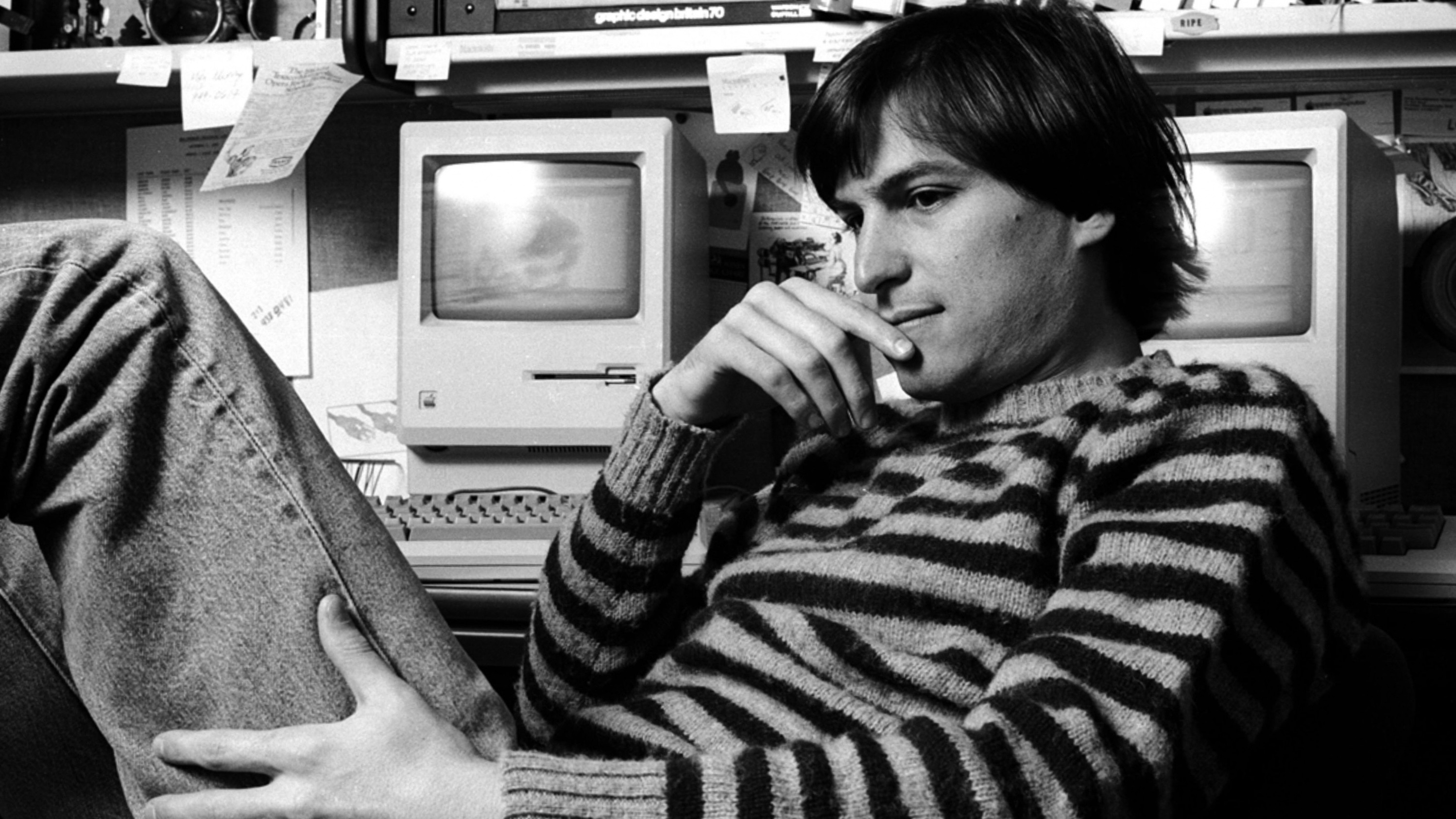
He had dropped out of Reed College. No money, no plan, no clear reason to stay. But Reed was known for its calligraphy program, maybe the best in the country, and something about it pulled him in. So he audited the classes. Learned about serif and sans serif typefaces. About the space between letter combinations. About what makes typography breathe. None of it had any practical application to his life. He wasn’t building computers yet. He wasn’t building anything. He was a dropout sleeping on floors and returning Coke bottles for grocery money.
Ten years later, he designed the Macintosh. And the Mac became the first personal computer with beautiful typography. Every font, every spacing decision, every detail that made people feel something when they looked at a screen. It all traced back to a calligraphy class he wandered into for no rational reason.
His words were simple. You can’t connect the dots looking forward. You can only connect them looking backward. So you have to trust that the dots will somehow connect in your future.
Read that through the paradox.
Jobs didn’t take calligraphy because he foresaw the Mac. He took it because something in him said this matters. He couldn’t name why. He didn’t need to. He was placing a totem at a coordinate he hadn’t fallen to yet. The calligraphy was the pickup. The Mac was the damage tick. And the connection between them only became visible when the projector head reached the frame where it all resolved.
That’s what collecting dots looks like. Not assembling a plan. Following a pull. A book that has nothing to do with your career. A conversation with someone outside your field. A skill that makes no sense on your resume. A question you chase down a rabbit hole at 2 AM for no reason other than it won’t let go of you.
These feel like distractions. They feel like noise. But they’re not. They’re totems. And you won’t know which fall they’re for until the tick resolves.
The block universe says the picture already exists. Every dot is already placed. The connections are already there, woven into the geometry of the strip. They just can’t be seen yet because consciousness is still moving through the frames where they look like scattered, unrelated points. But the frame where they snap into focus? That frame is as real as this one. It’s already there. You’re just not standing in it yet.
So you keep collecting. Not because you’re told to. Not because someone promised it would pay off. But because something in you recognizes the weight of a dot when you pick it up, even when your mind can’t explain why it matters.
That recognition is the totem entering your hand. And if the totem is entering your hand, then you know what comes next in the tick order.
Go back to the game one last time.
If eternalism is true, then your future self is not a hypothetical. Your future self is a location in spacetime that is as real as the version of you sitting here right now. The version of you that survived the fall, that figured it out, that got to the other side of the thing you’re scared of today. That version exists. Not “will exist.” Exists. In a frame you haven’t reached yet.
The totem is already in your hand. The pickup already resolved. The damage calculation hasn’t run from your perspective because consciousness is still in the phase of the tick where it feels like uncertainty. It feels like falling. It feels like not knowing if the save is there.
But that feeling is a property of being a projector head moving through frames. It is not a property of the film strip.
The strip already has the frame where you land, where the totem is equipped, where the damage calculates and you survive.
This is not a manifesto for laziness. The totem was there because someone placed it. Every version of you that ever chose the harder thing, the longer path, the preparation that felt pointless. You were dropping totems at coordinates you hadn’t visited yet. And the dots you’re collecting right now, the ones that don’t make sense, the ones you can’t justify to anyone who asks “what’s the point of that?” Those are the totems you can’t yet see the falls for. The picture they form already exists in a frame on the strip. You’re just not there yet.
The paradox is not “everything will work out.” The paradox is that the thing that saves you and the thing that threatens you are part of the same structure. The system that produces your falls is the same system that produces your saves. They can’t be separated. They’re features of the same geometry. The same strip. The same tick.
The anxiety about the future is real. It lives in this frame. But it is also already resolved in a frame that is equally real and equally present in the structure of spacetime.
This is not optimism. This is not faith. This is a Minecraft glitch, read through a century of physics, arriving at a conclusion that should make you feel something you rarely feel.
You’ve already survived. You’re just living inside the tick.
Equip it before the damage tick.